A ranked list creates an expectation that the entries have been judged against a common standard. In clinical research, that standard includes more than the condition’s name. It includes the population, the treatment being compared, the observation period and the definition of benefit. If those elements change between entries, a larger number may describe a different question rather than a better treatment.
Tone & Trace examines that issue through a study of tinted and untinted sunscreen. The scientific task is to distinguish an instrumental observation from a clinical outcome, and then identify what kind of comparison each permits. Prescription-cream research provides a second example with different success thresholds. Our interpretation concerns the evidence required for a relative-efficacy claim; it does not assume that any particular provider has cited these papers or participated in the experiments.
Download chart data (CSV)Download chart (PNG)
Study facts at a glance
Study design: 42 women randomized; 21 per group. [1]
Setting: Southern France; five months spanning summer. [1]
Primary assessment: Instrumental colorimetry. [1]
Secondary assessment: Modified Melasma Area and Severity Index (mMASI). [1]
Completion: 41 completers after one pregnancy withdrawal; final arm counts unreported. [1]
Related reading: A dark spot needs a name before a treatment · CoreAge Rx Spot On review
Define the comparison before choosing an order
A treatment ranking makes a comparative statement, even when it is displayed as a simple numbered list. To support a claim about clinical benefit, the comparison needs a defined outcome. A list ordered by documented price or formula disclosure could answer a different, narrower question. Our editorial interpretation is that the organizing criterion should be explicit so readers do not mistake one kind of order for another.
Consider a hypothetical pair of studies: one measures a short-term appearance score, while the other records whether a condition returns over a longer interval. Neither outcome is inherently unimportant. The problem arises if their results are converted into a single performance number without explaining how the outcomes relate. A mathematical scale cannot supply a clinical relationship that has not been established.
The ingredient-evidence guide offers a starting point for tracing an evidence claim to its actual subject. Here the next step is to name the comparison being proposed. Which product, used by which population, is expected to outperform which alternative on which endpoint? That question can be scientifically examined. A broad assertion that one cream is best leaves too many of those elements unstated to evaluate its meaning.
The sunscreen experiment tested specific preparations
The tinted preparation was Bioderma Photoderm M SPF50+ Golden, with pVL 66/UVA-PF 35/SPF 65; the untinted preparation had UVA-PF 36/SPF 64. These abbreviations describe visible-light protection, ultraviolet A protection and sun protection factor. They are product characteristics, each with its own interpretation, rather than interchangeable measures of clinical benefit.
A useful feature of comparing active preparations is that the investigator can ask a more focused question than whether any care differs from none. The tradeoff is that the result belongs to that comparison. It cannot automatically determine the effect of every ingredient in isolation or place an entire product category above another. The tested preparation remains the relevant unit when tracing the experiment to a commercial formula.
Our scientific interpretation also separates the reason for conducting a trial from what the trial establishes. A plausible protective property can motivate research without predicting the size of a clinical response. Demonstrating that property does not complete the clinical comparison. The sun-protection guide supplies further context for discussing protection within pigment care, while this study asks a more limited question about the observed performance of its two preparations.
Compare the options in top 5 dark spot creams & treatment options or read Hydroquinone prescriptions versus cosmetic serums.
A population match requires more than a photograph
Participants were 28–58 (mean 39.5), with phototypes III (93%) and IV (7%); investigators were blinded. Those descriptors help locate the evidence. They do not represent a cross-section of every age, skin type or pigment concern, and the age average should not be treated as a description shared by every participant.
Methodologically, the question of who was studied is different from how people were allocated. Randomization concerns the comparison inside an experiment. Applying its result to someone outside that experiment requires a further judgment about relevance. Masked assessment addresses another issue: whether knowledge of treatment assignment could influence the evaluation. These features contribute to evidence quality through different routes, so counting them together does not produce a universal applicability score.
A photograph may prompt a clinical question, but resemblance alone does not establish that two concerns have the same cause. The guide to naming a dark-spot concern before treatment helps frame that distinction. Our interpretation is that a diagnosis and a decision about evidence relevance belong before any attempt to choose a treatment from a ranking. A trial population is a reference for that discussion, not a substitute for assessing an individual concern.
Instrumental precision does not settle clinical importance
Assessments preceded application. L* describes lightness; ΔE measures color contrast between affected and adjacent skin. Contrast improved significantly within the tinted group, but not within the untinted group. The interpretive task is to understand what a contrast measurement adds and which questions remain outside its definition.
An instrument can provide a repeatable numerical observation without turning that observation into a complete description of disease. A difference between two areas depends on both readings. If the reference area changes, the difference can change even when the affected area follows another trajectory. This is a general property of subtraction, not an assertion that a particular unreported pattern occurred in the study.
A clinical meaning must therefore be attached carefully. A smaller contrast may matter to appearance, but deciding how much change people notice or value requires evidence about that relationship. An instrument’s ability to distinguish numbers does not establish a threshold of patient-important benefit. For comparative interpretation, the strongest next question is whether the observed optical difference corresponds to a defined clinical change, measured with appropriate uncertainty, rather than whether the number alone is sufficiently precise to sort products.
The clinical trajectory should remain on its own scale
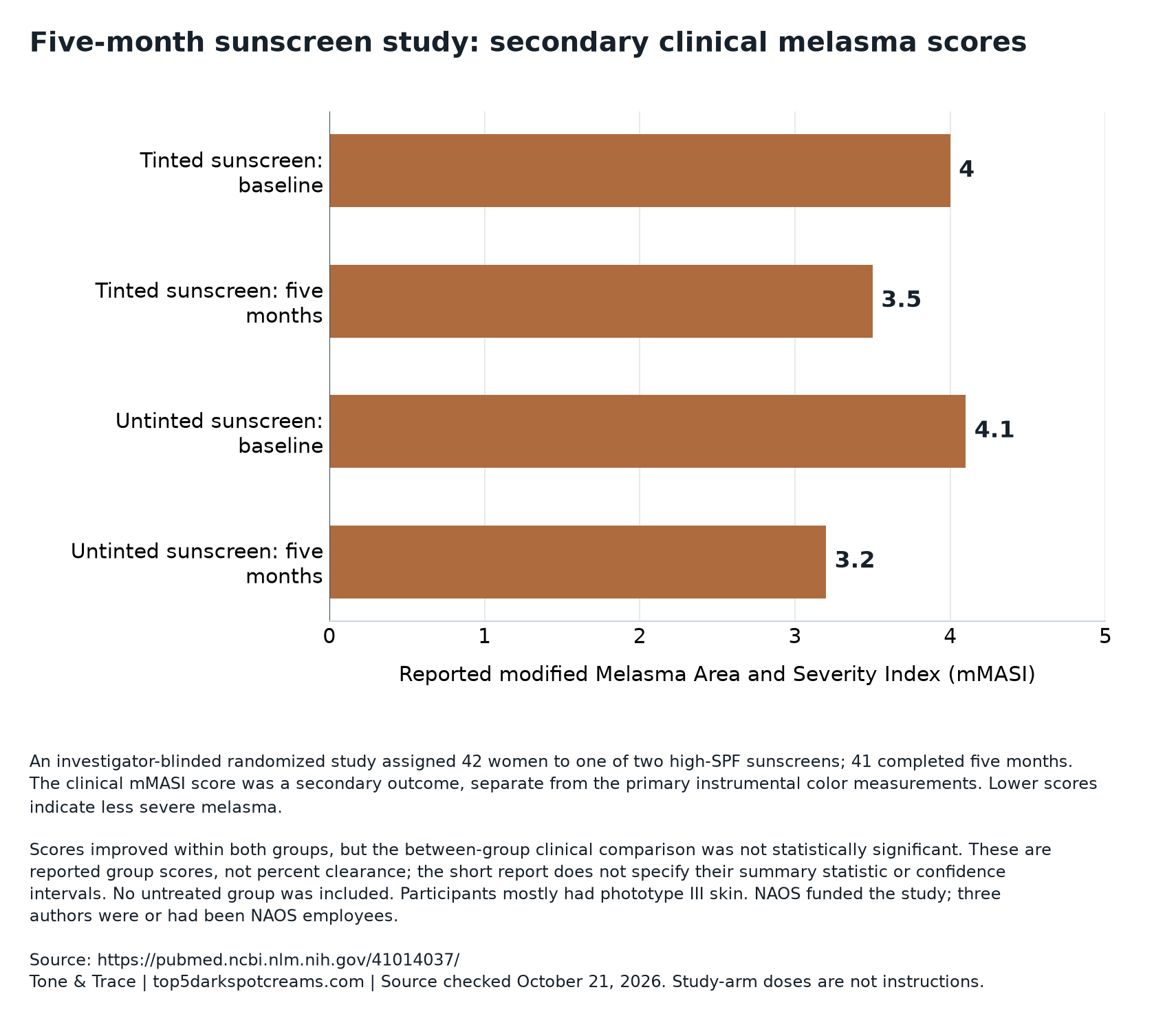
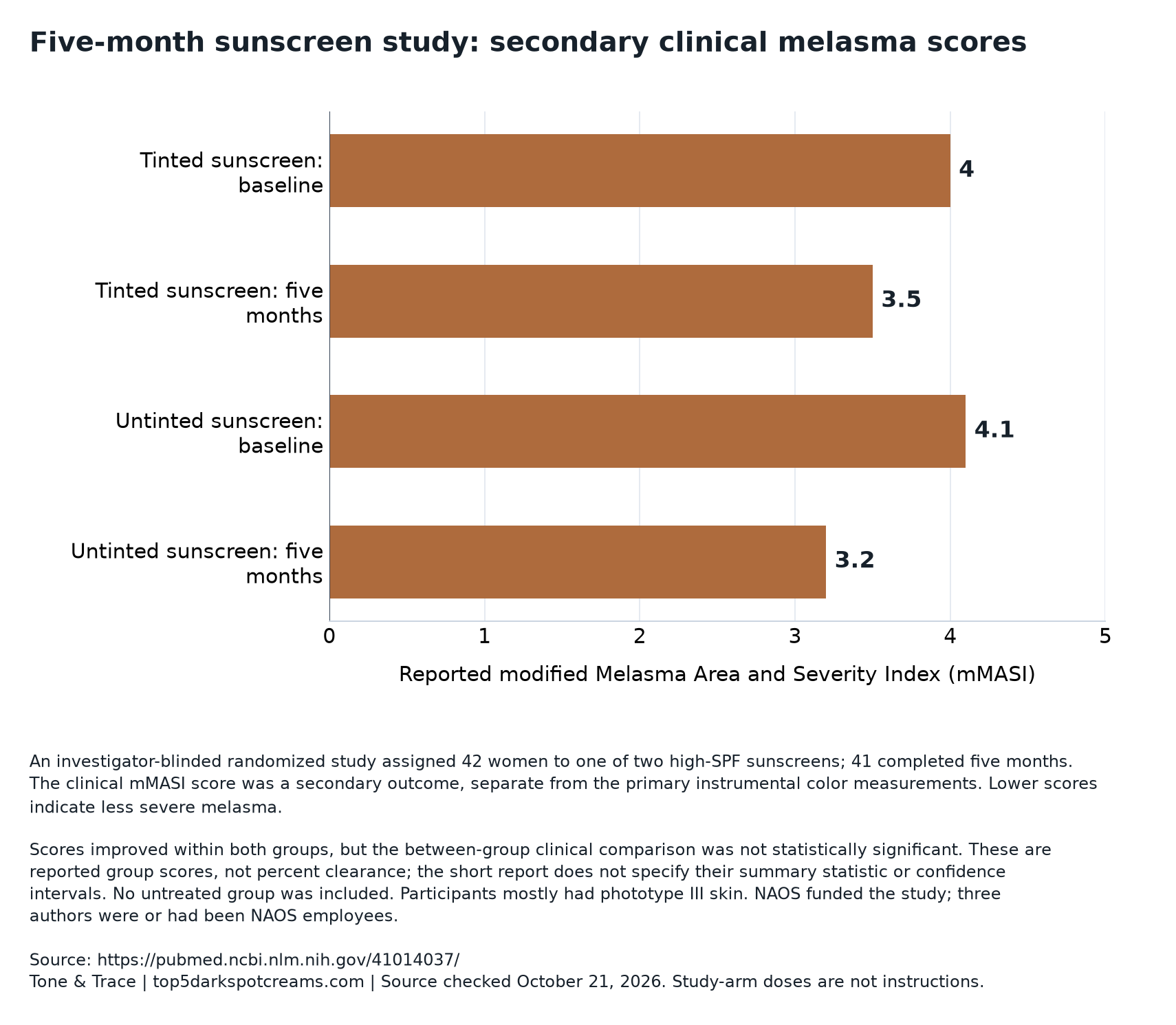
The reported mMASI scores appear below; their summary statistic was unspecified. Both within-group P values were <0.001, while the between-group comparison was nonsignificant. The display consequently identifies group scores without calling them means or converting them to a proportion of participants who responded.
The difference between those units matters. A score describes a measurement under a scoring system. A responder proportion requires a separate definition of response and a count of participants meeting it. An individual may cross a threshold by a small amount or exceed it substantially, yet contribute equally to that proportion. A group score does not reveal the distribution needed to perform that classification.
Our interpretation of the chart is descriptive: it shows the reported direction and values at the specified visits. It does not establish which preparation has superior clinical efficacy, and it does not predict an individual outcome. Even if a percentage change can be calculated arithmetically, its clinical interpretation depends on the properties of the scale. A convincing comparative explanation keeps the measurement units visible rather than substituting a more impressive-looking label.
| Preparation | Baseline score | Five-month score |
|---|---|---|
| Tinted | 4.0 | 3.5 |
| Untinted | 4.1 | 3.2 |
A difference in significance is not a treatment-effect estimate
The groups had baseline imbalances. That makes it important to distinguish a change from a starting value, a difference at the final visit and a comparison that accounts for the starting position. These analyses can address related questions while producing estimates with different meanings. The analysis should determine the claim, rather than the claim determining which number is selected.
A general statistical example helps. If two groups have similar estimated changes but different uncertainty, one within-group test might reach a conventional significance threshold and the other might not. That pattern alone says nothing decisive about the contrast between treatments. The contrast needs its own estimate and uncertainty interval. Subtracting the words significant and nonsignificant is not an analysis of the difference.
For the same reason, an inconclusive comparison is not proof that products are equivalent. Establishing equivalence requires a suitable question, an acceptable range of differences and an analysis capable of evaluating that range. Our reading does not reconstruct confidence intervals or numerical effects from the published plots. The full short article is available, but the supplement has not been independently examined here; greater detail about the analysis should be sought from that record rather than invented.
A longer promise needs the appropriate follow-up question
There was no untreated comparison. The experiment therefore cannot measure absolute benefit against an unobserved course without sunscreen. This is especially relevant when a claim changes from a comparison of products to prevention of recurrence. The hypothetical alternative should remain a question, not become an assumed control group after the results are known.
Time also changes the meaning of a result. In an illustrative scenario, two interventions could have different early and later patterns of response. Ordering them at one visit would not establish their order at another. This is not a proposed explanation for the sunscreen findings; it is the reason a comparative claim needs to retain its assessment time and avoid implying a longer observation than was performed.
Recurrence adds another definition: an event must be recognized after a specified prior state. A series of color measurements does not automatically identify when disease returned or how frequently it did so. A study intended to address lasting control would need a clear event rule, relevant follow-up and an appropriate comparison. Our interpretation is that a bounded observation remains useful when described accurately, while a broader promise calls for a different body of evidence.
Prescription studies show why thresholds cannot be swapped
The separate Chinese triple-combination trial randomized 53 people; 52 entered its modified intention-to-treat analysis. Its primary endpoint required a two- or three-grade decrease on the Melasma Severity Scale (MSS). The US Tri-Luma label trials used MSS zero, or cleared, and compared the triple combination with dual-ingredient creams. These are different success criteria and study comparisons.
The eight-week prescription-trial article explores that study’s findings in detail. Here, the table illustrates the endpoint problem. The same treatment name can appear in research records with different definitions of benefit. Its presence does not make the denominators, participants or response thresholds interchangeable, and it does not establish a direct comparison with the sunscreen experiment.
A valid synthesis would first ask whether the studies address a sufficiently similar question to combine. It would then need a method that accounts for relevant differences and uncertainty. Simply dividing the displayed counts and ordering the resulting percentages skips those steps. A threshold that is easier to cross can produce a larger response proportion without showing that a treatment is more effective. That is a methodological possibility, not an explanation assigned to the differences between these particular trials.
| Study record | Reported counts | Primary success rule |
|---|---|---|
| Chinese eight-week trial | Generic 12/23; Tri-Luma 12/21; vehicle 0/8 | MSS decrease of two or three grades. |
| US label trial 1 | Tri-Luma 32/85 | MSS zero: cleared. |
| US label trial 2 | Tri-Luma 10/76 | MSS zero: cleared. |
Safety and sponsorship require their own reading
Both sunscreens were described as well tolerated, without comparative adverse-event counts. NAOS Ecobiology Company funded the study; three authors were current or former employees, and Thierry Passeron disclosed industry honoraria. These are documented observations and relationships. Neither a general tolerance statement nor an employment disclosure replaces an assessment of the study’s methods.
The Chinese paper reports support from the Scientific Research Fund of Zhejiang Provincial Education Department and Zhejiang Fonow Medicine, which supplied products; its authors declared no conflicts. That funding record belongs to the prescription trial. Keeping support and product supply attached to the correct experiment avoids implying that one sponsor funded every study mentioned in an evidence comparison.
Our safety interpretation distinguishes the absence of quantified reporting from a demonstrated absence of risk. A descriptive statement cannot provide a reliable frequency for an event without suitable counts, denominators and follow-up. Similarly, commercial support is a reason to examine outcome selection, reporting completeness and access to data, not a numerical penalty that can be subtracted from an efficacy score. A transparent comparison keeps those judgments visible instead of hiding them inside an unexplained overall rating.
Provider comparisons need evidence about the provider
FDA says OTC hydroquinone skin-lightening products lack approval for safety and effectiveness and notes reports of rash, facial swelling and potentially permanent ochronosis. The prescription Tri-Luma label separately identifies short-term facial-melasma use, excludes maintenance, and warns about irritation, hypersensitivity and blue-black ochronosis. These records do not establish the status of an unspecified compounded product.
Our editorial interpretation is to keep a provider’s documentation separate from a trial’s treatment estimate. The US hydroquinone rules guide explains the regulatory distinction. Documentary reviews of Musely and Agency can help a reader examine the corresponding offer and product records. Linking them does not imply either service supplies the tested sunscreen, took part in the trial or produces its outcomes.
A provider comparison can be useful when it states exactly what has been compared and the evidence supporting that comparison. Scientific efficacy is a separate claim requiring suitable outcomes data. Tone & Trace’s interpretation is that formula identity, access terms and clinical results should remain identifiable throughout the explanation. That allows a reader to recognize a documented difference without assigning it an unmeasured effect on health or turning an unrelated trial into a provider endorsement.
What this evidence supports
The sunscreen study offers a useful lesson in the structure of comparison. An optical observation, a clinical score and a clearance threshold each describe something specific; none should become a universal measure of treatment quality through relabeling. Our assessment is that a credible ranking must identify a shared question and explain how its evidence answers it. When that support is absent, a clear comparison of documented features remains possible, but it should retain its stated purpose. Research results are most useful when the product, population, endpoint and uncertainty remain traceable all the way to the conclusion.
Research access and limitations
This reading uses the full short sunscreen article and funding footnote, the separate Chinese prescription trial, official Tri-Luma labeling and FDA’s consumer notice. It does not claim review of the sunscreen supplement, extract numerical plot values or reconstruct confidence intervals. Illustrative statistical scenarios are reasoning examples rather than observations. No individual prescription or commercial-provider outcome is inferred.
Questions about the evidence
Can a ranking combine appearance scores and clearance rates?
It can discuss both, but it needs to explain their different meanings. Producing a single clinical order would require a justified way to relate the outcomes, along with compatible comparisons and uncertainty. Our interpretation is that placing unlike numbers in one column does not supply that justification. [1] [2] [3]
Does the study prove that all tinted sunscreens perform similarly?
The findings concern the preparations tested under the study conditions. Extending them to other formulas requires evidence of the relevant relationship between products. A shared descriptive category is insufficient to establish either comparable optical performance or comparable clinical outcomes. [1]
What makes a chart label scientifically useful?
A label should identify the variable, its units and any summary method supported by the report. If information is unavailable, the wording should leave that limitation visible. Precision in the label helps prevent a graphic from suggesting a more detailed analysis than its evidence establishes. [1]
What would strengthen a claim about long-term control?
A study would need to define the clinical state being maintained, specify what constitutes recurrence and observe participants for a relevant period with an appropriate comparison. Those are proposed evidence requirements, not additional findings from this experiment or a plan for an individual’s treatment. [1] [3]
Can a provider inherit an ingredient’s clinical results?
An ingredient reference does not establish a provider-level outcome. The exact product, population, treatment context and measured result still need to be connected. Our editorial approach uses provider reviews to inspect documentation while reserving efficacy claims for evidence that actually evaluates the relevant intervention and outcome. [1] [2] [3]
Sources and verification
Official pages establish product facts and provider claims. Clinical and regulatory sources answer separate evidence questions. Article checked October 21, 2026; individual source dates appear below. No medical reviewer is credited for this article.
- Comparison of Visible Light-Protective Tinted Sunscreen to Untinted Sunscreen to Protect Melasma Patients During Summer: A Prospective Randomized Investigator-Blinded Study. ↗ · Checked October 21, 2026 · Full primary research letter plus verified PMC funding footnote; supporting-information document and figure-derived numerical data not reviewed
- Efficacy and Safety of Generic Fluocinolone Acetonide, Hydroquinone, and Tretinoin Cream Compared With TRI-LUMA for the Treatment of Moderate-To-Severe Melasma in Chinese Patients: A Randomized, Single-Center, Placebo-Controlled Trial. ↗ · Checked October 21, 2026 · Full research article, with indexed abstract where available
- DailyMed: TRI-LUMA fluocinolone acetonide, hydroquinone, and tretinoin cream prescribing information ↗ · Checked October 21, 2026 · Full official prescribing information
- FDA warns consumers of skin products containing mercury and/or hydroquinone ↗ · Checked October 21, 2026 · Current FDA consumer safety notice, introductory safety text read; individual product-testing table is not used for provider comparisons.