Sorting numbers is easy. Deciding whether they measure the same achievement is the harder part of a cream comparison. A higher response percentage might reflect a different definition of response rather than a more effective product. It might also describe a different population, comparison or point in time. Tone & Trace examines an eight-week melasma trial to show why those details must be established before clinical results are used to place products in order.
The evidence includes the full primary cream report, official US prescribing information, an original sunscreen research letter and the FDA’s consumer notice. Our analysis keeps clinical measurements separate from the product and service records that readers encounter in reviews. This is a framework for interpreting evidence, not a claim that any named provider uses these results in its marketing. A useful comparison should explain its basis well enough that another reader can trace the same path from a source to a conclusion.
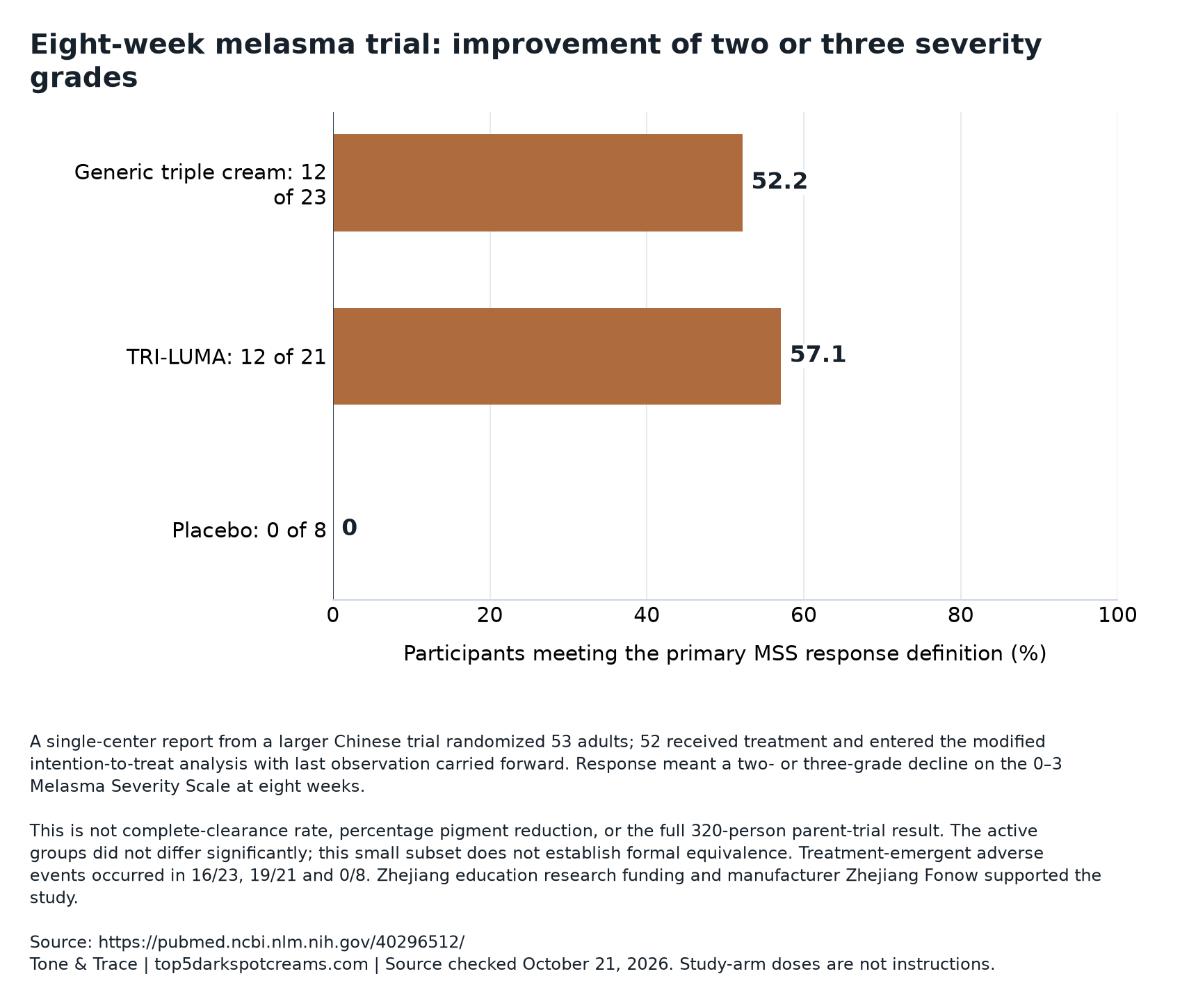
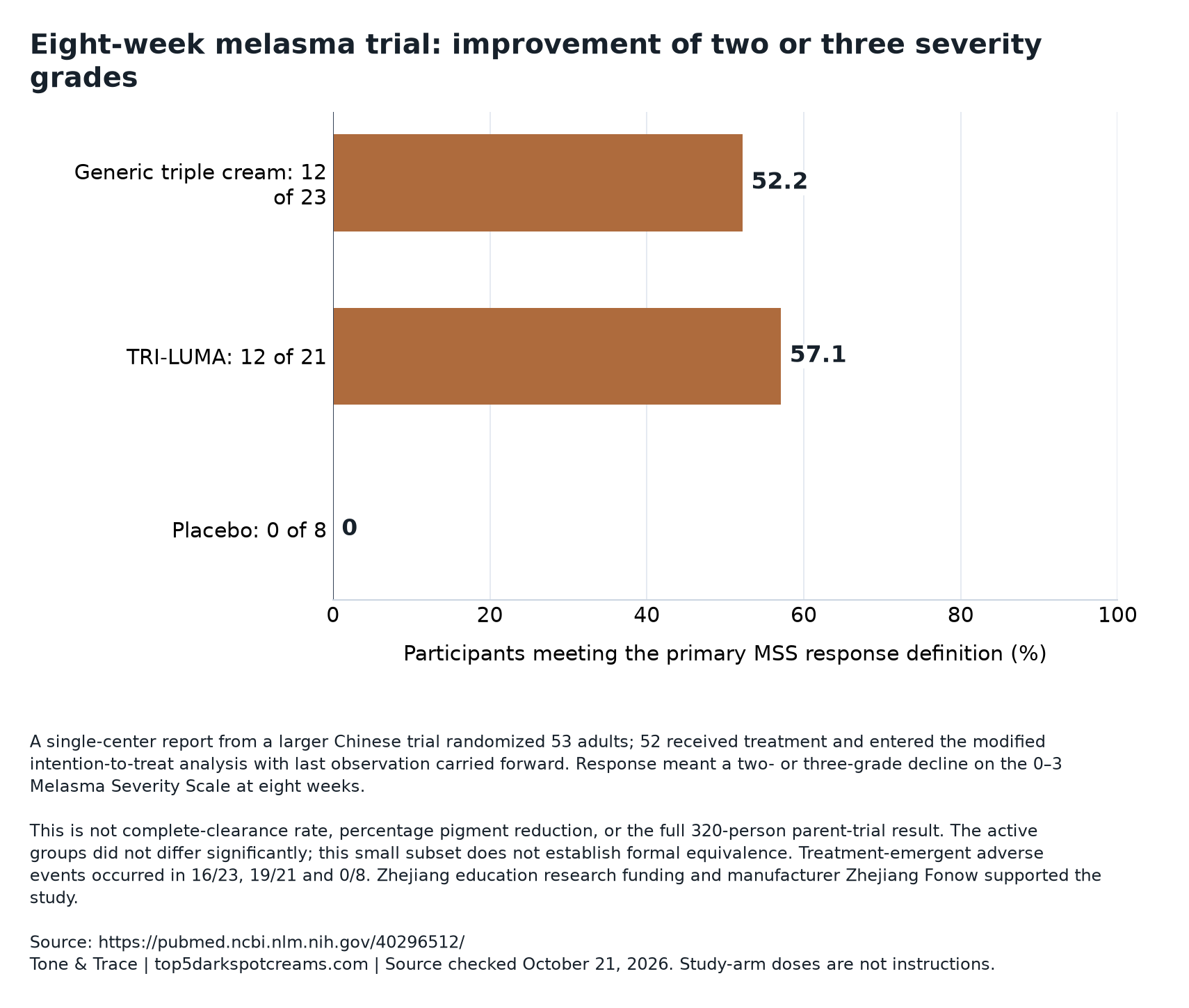
Download chart data (CSV)Download chart (PNG)
Study facts at a glance
Experiment: Randomized, double-blind, single-center Chinese study; eight weeks. [1]
Population accounting: 53 randomized; 52 analyzed; 44 completed. [1]
Formulation: Topical hydroquinone 4%, tretinoin 0.05% and fluocinolone acetonide 0.01%. [2]
Approved-use boundary: US Tri-Luma labeling specifies short-term moderate-to-severe facial melasma treatment, not maintenance. [2]
Regulatory distinction: FDA reports no approved or legally marketed OTC skin-lightening products. [3]
Related reading: A dark spot needs a name before a treatment · CoreAge Rx Spot On review
Define the comparison before assigning an order
A clinical ranking needs a clearly stated target. Is the goal a larger short-term change in severity, complete clearing, fewer reactions or a longer period without recurrence? These are different outcomes, and a product could appear favorable on one without resolving another. Combining them into a single position requires decisions about what counts most. Those decisions should be identified as judgments rather than presented as a result that the experiment itself calculated.
For an illustrative example, suppose one hypothetical study reports that 70% of participants achieved at least 30% improvement, while another reports that 45% achieved at least 70% improvement. Putting the first result above the second because seventy exceeds forty-five would rank unlike achievements. The numbers alone do not reveal which treatment produces better outcomes under a common rule. This invented example demonstrates the comparison problem; it does not describe either study reviewed here.
The condition being measured belongs in that definition as well. Our guide to naming a dark-spot concern helps frame the assessment question. A diagnosis cannot be supplied by a product category or by a numerical result taken from people whose condition was already defined for research.
Keep the actual alternatives inside the experiment
The primary outcome was a two- or three-grade decline on the 0–3 Melasma Severity Scale. The table records the comparison among the generic combination, Tri-Luma and vehicle. A response under this rule can include residual scored severity, so it should not be renamed complete clearing. It also counts people meeting a threshold, rather than an amount of pigment removed from an individual.
A shared experiment offers a defined setting in which alternatives are assessed. Extending its ordering to another cream would introduce a comparison that has not been observed. Even a recognizable active ingredient does not establish that the complete formulation, background care or diagnostic context matches. The missing connection should be made visible rather than filled by the assumption that all creams with overlapping ingredients behave alike.
Our ingredient-evidence guide provides a companion to this distinction. As a methodological interpretation, evidence about a mixture does not isolate each component’s contribution. To learn whether a component is necessary, sufficient or responsible for a particular difference, a study needs appropriate component comparisons. A list of ingredient names cannot perform that experimental task, and a review should not treat it as though it has.
| Study arm | Response count | Response percentage |
|---|---|---|
| Generic combination | 12/23 | 52.2% |
| Tri-Luma | 12/21 | 57.1% |
| Vehicle | 0/8 | 0% |
Compare the options in top 5 dark spot creams & treatment options or read Hydroquinone prescriptions versus cosmetic serums.
Separate the enrolled population from completed observations
Participants were mostly women aged 33–55 with moderate-to-severe melasma, predominantly epidermal. All received cleanser, moisturizer and sunscreen. One untreated participant was excluded; missing follow-up used last-observation-carried-forward. This last method retains an earlier recorded state where a later measurement is unavailable. It does not demonstrate that the participant remained in that state throughout the unobserved period.
Population accounting matters because an apparently simple percentage contains choices about whose outcomes contribute. Using only completed visits can select a different set of people from the original assigned groups. Retaining earlier measurements avoids discarding those records but introduces its own assumption. A reader should examine that assumption instead of treating any method for missing data as if it recreates the missing observations.
The people who actually participate also determine how far the evidence reaches. Eligibility rules describe who could enter; enrollment describes who did. Neither should be replaced with a general claim about everyone interested in pigment care. Our melasma and post-acne-mark guide addresses one practical boundary. Shared language about uneven tone does not establish that different conditions have the same response pattern or that findings from a defined research population answer another clinical question.
Place each percentage beside its measurement rule
The Melasma Area and Severity Index, abbreviated MASI, permits more than one summary. A responder proportion counts how many people cross a threshold. A mean percentage change summarizes the size of changes across the group. Those summaries can move differently because one compresses outcomes into categories and the other combines their magnitude. The table distinguishes them from clearing and color measurements in the other evidence records.
Imagine two hypothetical groups with the same average change. One could have similar moderate improvements in nearly everyone; the other could contain a mixture of large improvements and little change. A threshold might classify those groups very differently. This is why an average cannot be translated into the percentage of people who achieved a particular result without information about the individual distribution.
The same discipline prevents a subtler mistake: changing the object represented by the percentage. A proportion of participants is not a proportion of disease eliminated, and a relative change in a score is not automatically a percentage-point difference between groups. A comparison becomes more legible when its units are written out. It becomes less legible when a convenient percent sign hides that the underlying question has changed.
| Evidence and measure | Reported result | What is summarized |
|---|---|---|
| Cream trial: MASI improvement of at least 50% | Generic 69.6%; Tri-Luma 81.0% | Participants meeting a threshold |
| Cream trial: mean MASI reduction | Generic 63.2%; Tri-Luma 72.9%; vehicle 24.7% | Mean percentage change in score |
| US label: severity score zero | Trial 1: 32/85 (38%); trial 2: 10/76 (13%) | Tri-Luma participants with complete clearing |
| Sunscreen study: primary colorimetry | Color measurements, not a clearance percentage | Pigmentation and contrast measurements |
A label trial does not create a universal product league table
The label’s clearing trials compared Tri-Luma with dual-active combinations. That comparison asks a different question from an experiment using vehicle and another complete combination. A partial combination can help investigate the value of the full intervention relative to that particular alternative. It does not establish the relative performance of every product that shares one of the ingredients.
Separate trials may also differ in starting severity, participant selection, assessment and concurrent care. Identifying such differences is necessary for evaluating comparability, but their presence does not prove which one explains a numerical gap. A review should avoid narrating an explanation as if the studies had experimentally isolated it. An observed difference between reports and an explanation for that difference are separate levels of evidence.
The label does not establish efficacy for other hyperpigmentation conditions or phototypes V and VI. Those limits remain relevant when discussing product applicability. For documentary navigation, readers can inspect the CoreAge Rx Spot On review. This link does not assert that its product matches the trial, that it provides a particular clinical service or that the reported percentages predict its outcomes. Connecting a provider record to clinical evidence requires direct support at each step.
A close numerical result is not an equivalence finding
The active-arm comparison was nonsignificant; equivalence was not established. A difference test and an equivalence analysis are not interchangeable ways to ask the same question. Equivalence requires a defensible range of acceptable differences and evidence precise enough to remain within that range. A result that does not establish a difference may still leave clinically important possibilities unresolved.
A useful visual thought experiment is to place an uncertainty interval around an estimated difference. If it extends well beyond the acceptable boundaries, the estimate does not establish equivalence even when its center lies close to zero. If it fits within the boundaries, that addresses a different evidentiary requirement. This is an explanation of the method, not a reconstructed confidence interval or a recommended clinical margin for this trial.
The kind of uncertainty must also be named accurately. A standard deviation describes variation among observations; a confidence interval describes uncertainty around an estimate under stated assumptions. Using one label in place of the other changes the interpretation. For a product comparison, our editorial judgment is to retain the unresolved range of possibilities rather than treat the absence of a detected difference as permission to rank the products together on every dimension.
Safety belongs beside benefit, with its own counting rules
Treatment-emergent events occurred in 16/23 generic and 19/21 Tri-Luma participants; the overall comparison was nonsignificant. Irritation was 12/23 versus 17/21 (P<0.05). One Tri-Luma participant withdrew for exfoliation. An event-specific comparison should not become a global safety verdict. The outcome, its severity and its effect on participation all matter when interpreting the experience described by a count.
Counting people with any event is different from counting individual events. A person can report more than one symptom, so adding category percentages can count that person several times. Comparisons across sources also require attention to attribution: events emerging during observation and events classified as treatment-related are different categories. A larger percentage under one definition cannot automatically be read as a larger causal risk under another.
The US label warns about irritation, ochronosis, sulfite reactions and systemic corticosteroid effects. These warnings are not replaced by a favorable average benefit or by a short list of observed symptoms. The hydroquinone safety guide is a place to organize monitoring questions. Our interpretation is that a clinically meaningful comparison needs both benefit and harm information, while decisions for an individual still require assessment of the actual product and circumstances.
The follow-up period determines which durability question was tested
No atrophy or telangiectasia was reported over eight weeks. This observation cannot characterize every longer period or every uncommon outcome. Duration affects the opportunity to observe an event, while the number and characteristics of participants affect what might be encountered. The appropriate statement retains that observation window rather than turning the lack of an event into a prediction about indefinite use.
The label notes that melasma usually recurs after treatment ends. To study durable control, researchers would need to specify the state being maintained, the beginning of follow-up, the definition of relapse and subsequent care. Improvement at a treatment-period visit does not answer all those questions. A ranking that combines durability with short-term response therefore requires evidence for both instead of allowing one to stand in for the other.
The separate tinted-sunscreen investigation lasted five months; its clinical mMASI comparison was nonsignificant between groups. It was not a follow-up of the cream participants. The longer calendar and the instrument-based color endpoints do not supply missing cream outcomes. Our synthesis is that these studies can inform different parts of a clinical conversation while remaining distinct experiments with distinct measurements.
Keep regulatory status and commercial documentation separate
FDA records reports of rash, facial swelling and potentially permanent ochronosis involving hydroquinone skin-lightening products. Such reports identify concerns without providing a controlled comparison or the denominator needed to estimate a personal event rate. The agency’s OTC statement is also distinct from the prescription product’s approval. Neither record alone establishes the regulatory status or performance of an unexamined compounded preparation.
Our US hydroquinone rules guide provides context for that distinction. As an editorial principle, regulatory identity, product identity and observed clinical effects should be documented separately before a claim connects them. An ingredient name does not establish approval, and a purchase route does not prove that a clinical outcome has been reproduced. Those are different propositions requiring different records.
The Musely The Spot Cream review is linked for inspection of documentary terms, without an assertion that its formulation matches the study or inherits its results. A provider’s disclosed offer may be useful to compare for practical reasons. That comparison should identify its basis rather than allowing a service description, price or website presentation to imply relative clinical efficacy that has not been established.
Show the support for the study and the support for the conclusion
The cream study was supported by Zhejiang education grant Y201839775 and Fonow; Fonow supplied products. Authors declared no conflicts. NAOS Ecobiology Company funded the sunscreen study; three authors were current or former employees, and Passeron disclosed industry honoraria. These statements describe documented support and relationships. They should not be replaced with guesses based on a company name appearing in a paper.
Transparency about support is one part of evaluating evidence, not a substitute for reading the design and results. A funding relationship does not supply a numerical correction to an estimate or prove that a specific conclusion is wrong. The productive questions concern how the primary outcome was chosen, how missing observations were handled, what uncertainty was reported and whether the conclusion stays within those boundaries.
A review can make that process visible by separating reported findings from its own reasoning. The evidence may support a particular within-study comparison while leaving a commercial ranking unresolved. Our editorial assessment is that showing this gap helps readers more than assigning a precise-looking position that depends on unlike endpoints. Traceability means a reader can identify the source of a number, the inference made from it and the additional evidence needed to extend the claim.
What this evidence supports
The trial supports a defined discussion of response under its own measurement rules. It does not supply a ready-made ranking of every cream, ingredient or provider associated with pigment care. Our interpretation is that a stronger comparison begins by matching the clinical question, then retains the uncertainty and safety context that accompany the answer. Keeping improvement, clearing, tolerability and durability distinct makes the evidence easier to evaluate. It also lets practical product comparisons remain useful without implying a level of clinical comparison that the underlying studies have not performed.
Research access and limitations
This analysis examines the full single-center cream report, not an unpublished analysis of the parent trial. It does not reconstruct participant outcomes, equivalence intervals or numerical values from sunscreen figures. The sunscreen research letter and verified funding footnote were read; the supporting-information document is not represented as reviewed. Official labeling and FDA material were checked October 21, 2026. No provider’s current formulation, service or clinical outcomes are verified by these research findings.
Questions about the evidence
Can a percentage from one trial be compared with a percentage from another?
It can be discussed alongside another result, but a clinical comparison needs more than the shared unit. Check whether the endpoint, analysis population, comparator and timepoint are sufficiently comparable, and identify remaining differences. Simple numerical ordering does not adjust for those differences. A review should explain its assumptions rather than present an untested cross-study ranking as a direct experimental finding. [1] [2] [4]
Does the word responder mean the condition cleared?
Only if the study defines a response that way. A responder is someone who meets the specified rule, which might concern change from baseline, a final state or another measure. Read that rule before interpreting the proportion. Changing the label from improvement to clearance changes the clinical claim even if the percentage remains exactly the same. [1] [2]
Why is the complete formulation more informative than one active name?
The experiment evaluates a defined intervention, not every possible product containing one of its ingredients. Other components, concentrations and conditions of use belong to that identity. Evidence about a whole combination cannot isolate each component’s contribution without appropriate comparisons. Ingredient overlap is therefore a starting point for investigating relevance, not proof of interchangeable outcomes. [1] [2]
Would an overall review score resolve the different outcome measures?
A combined score can express an editorial decision about priorities, but it does not make unlike clinical endpoints identical. Its weights and assumptions would need to be explicit, and it should not imply a head-to-head clinical result where none exists. Practical documentation can be compared on its own terms without claiming that the resulting order measures relative treatment efficacy. [1] [2] [4]
What evidence would make a comparative claim stronger?
A comparison designed around the relevant finished products, condition, outcome and follow-up would provide a clearer basis. It should report meaningful uncertainty, describe harms and make its approach to incomplete data understandable. These features support interpretation; they do not guarantee which product would perform better. The most useful next question is the one that addresses the specific missing connection in the proposed claim. [1] [2]
Sources and verification
Official pages establish product facts and provider claims. Clinical and regulatory sources answer separate evidence questions. Article checked October 21, 2026; individual source dates appear below. No medical reviewer is credited for this article.
- Efficacy and Safety of Generic Fluocinolone Acetonide, Hydroquinone, and Tretinoin Cream Compared With TRI-LUMA for the Treatment of Moderate-To-Severe Melasma in Chinese Patients: A Randomized, Single-Center, Placebo-Controlled Trial. ↗ · Checked October 21, 2026 · Full research article, with indexed abstract where available
- DailyMed: TRI-LUMA fluocinolone acetonide, hydroquinone, and tretinoin cream prescribing information ↗ · Checked October 21, 2026 · Full official prescribing information
- FDA warns consumers of skin products containing mercury and/or hydroquinone ↗ · Checked October 21, 2026 · Current FDA consumer safety notice, introductory safety text read; individual product-testing table is not used for provider comparisons.
- Comparison of Visible Light-Protective Tinted Sunscreen to Untinted Sunscreen to Protect Melasma Patients During Summer: A Prospective Randomized Investigator-Blinded Study. ↗ · Checked October 21, 2026 · Full primary research letter plus verified PMC funding footnote; supporting-information document and figure-derived numerical data not reviewed